Your Salesforce Quick Reference Guide

You've done the training session — this guide is your reminder. It walks through the workflow to find your account, log what happened, and let Salesforce keep the frequency clock honest for you.
Smiling woman in black uniform holds open a glass door with Sheen Panel Service office signage.

The one rule

If it isn't in Salesforce, it didn't happen. Log all relationship calls and proactive visits — that's what keeps your store's frequency status green.

Quick User Guide

The 30-second cheat sheet

Log an activity in 6 clicks

  1. Search the client's name in the top bar → open the account.
  2. Click the phone icon in the Activity panel.
  3. Subject: say what it was ("Lunch with Steve").
  4. Type: Call, Visit or Other — pick honestly.
  5. Date: backdate if it already happened; future-date to schedule.
  6. Comments + link the contact → Save. Frequency clock resets itself.

Part One · Know Your Screen

The Home Dashboard

This is the first screen you see when you log in. It answers one question: is my store proactively building relationships with our clients?

1

Read your Activity Tracking Dashboard
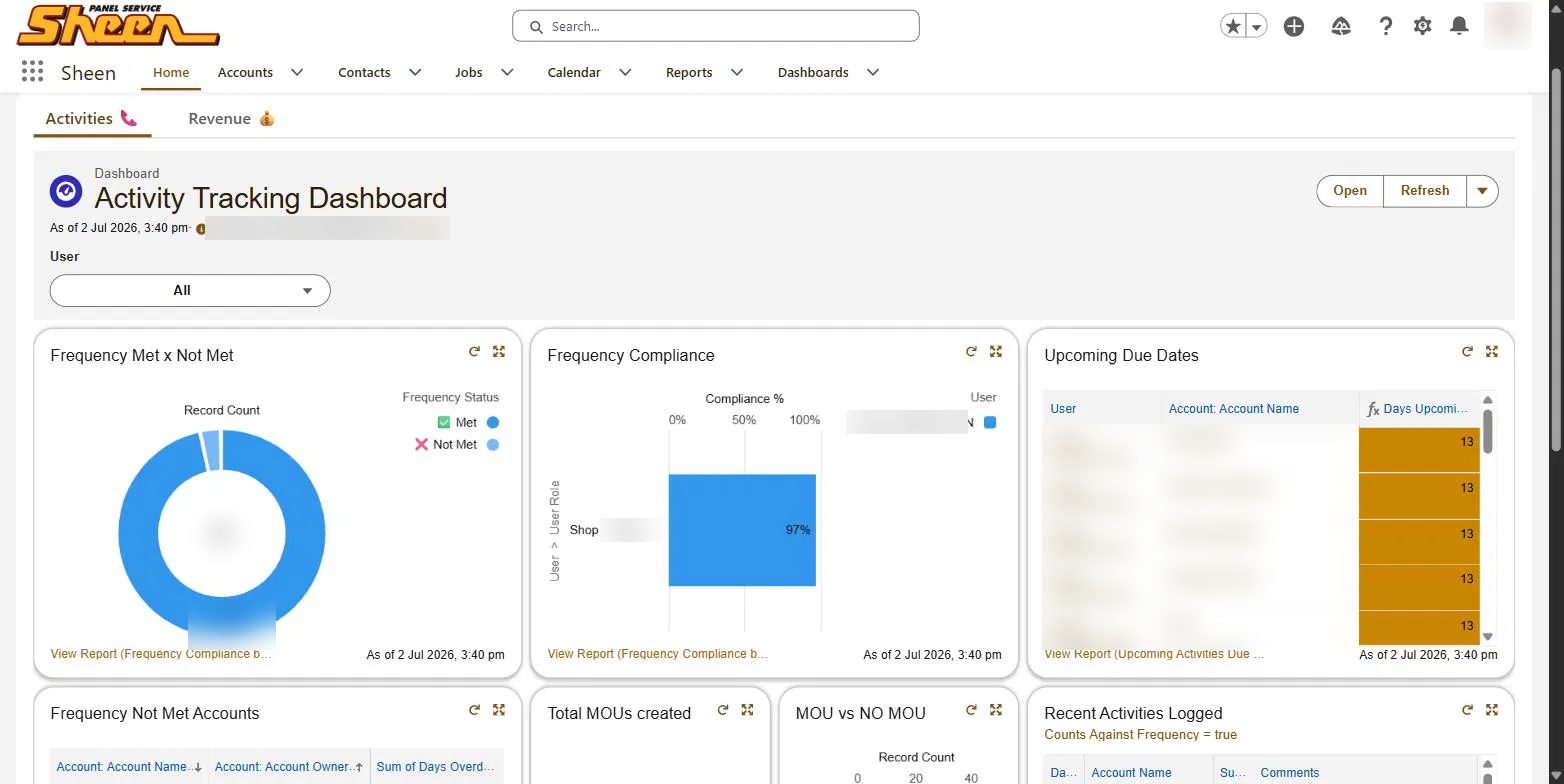
Dashboard showing charts and tables for activity tracking, frequency met, compliance, due dates, and MOUs created.
Three panels do the work:
Panel What it tells you
Frequency Met × Not Met The big donut. One number for the whole business — how many accounts have been contacted inside their required frequency.
Frequency Compliance On this bar chart, the goal is for it to sit at 80%+.
Upcoming Due Dates Your to-do list — shows anything due within 14 days. Colour tells you the urgency: Green = due more than 14 days away, Yellow = due within 14 days, Red = overdue.

Make it a habit

Check Upcoming Due Dates once a week. If your store's name appears next to an account, that's your visit or call to make.

The 3-a-week habit

Don't wait for the clock to run out — call 3 clients a week, every week. Staying in front of clients before they're due is what keeps the relationship warm and the compliance green.

Part Two · Find The Account

Getting to the right record

2

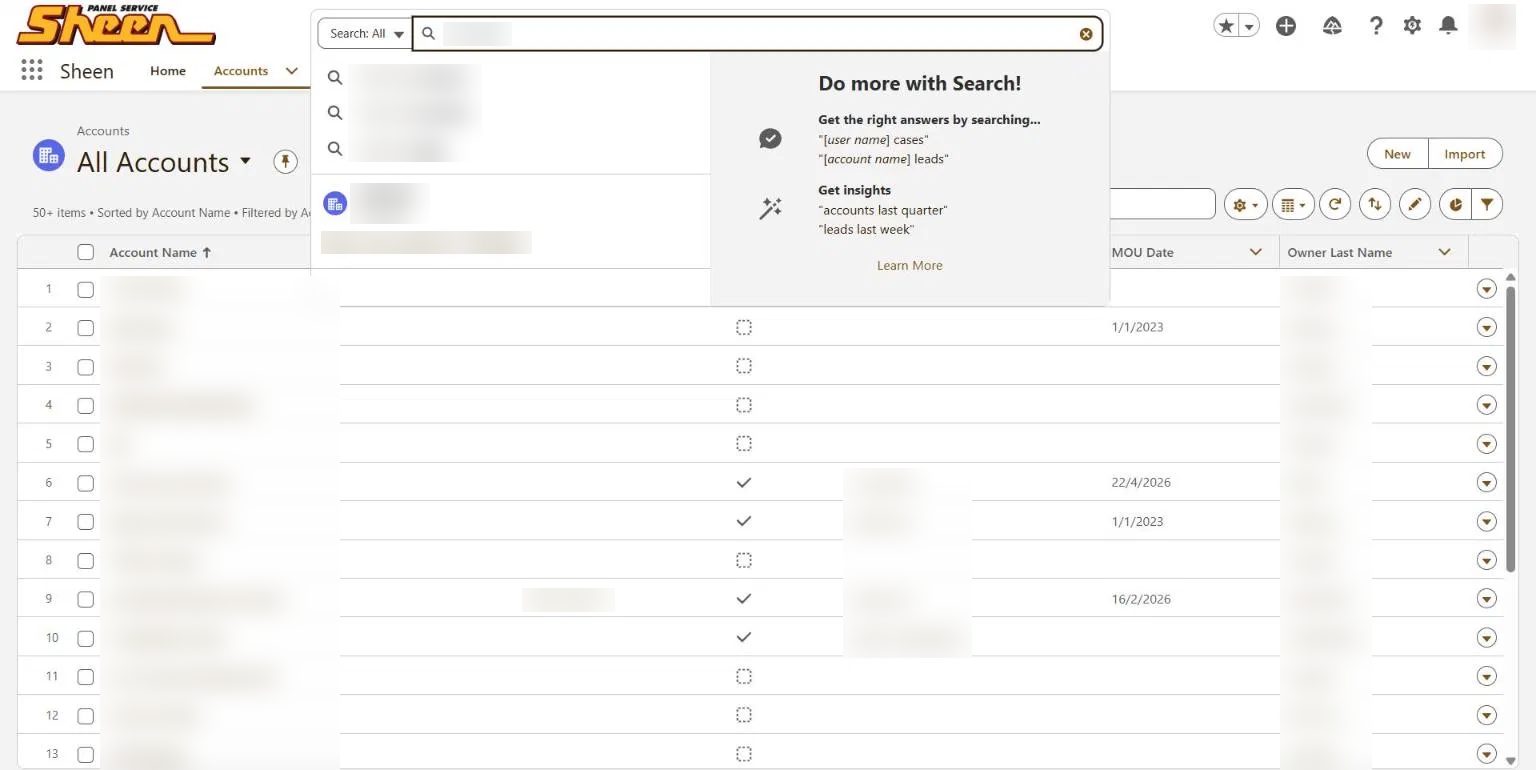
Search for the account
Dashboard interface showing Sheen panel service with account list and search feature.

The fastest way in is the search bar at the very top of every screen. Start typing the client's name and Salesforce suggests matching accounts, contacts and tasks as you go — click the account name in the dropdown.

You can also browse via Accounts → All Accounts, but with the number of clients in the system, search wins every time.

Can't find it?

First, remember you can only see your own store's accounts — if a client belongs to another store or the Fleet team, it won't appear for you. Otherwise check spelling and try a shorter fragment (e.g. "360" instead of "360 Fleet Pty Ltd"). If the account genuinely should be yours and isn't there, contact Dean before creating a new one — duplicates break the reporting.

3

Read the account record

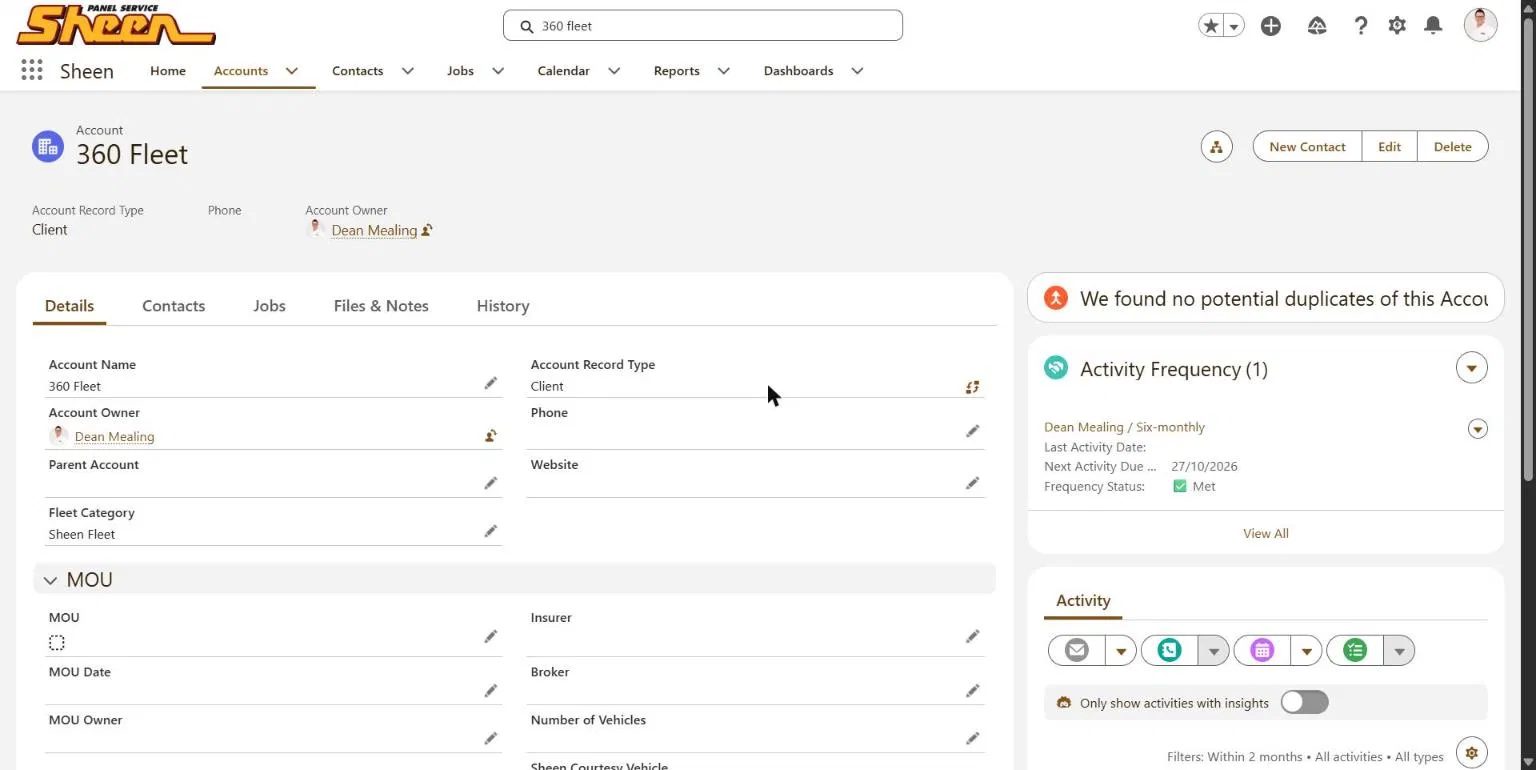
User interface showing account details for 360 Fleet with owner Dean Mealing and MOU information in a CRM system.
Everything about the client lives here. The parts you'll use most:
Area What's in it
Details tab Account name, owner, Fleet Category, phone and website.
MOU section Fleet agreement info — MOU date, owner, insurer, broker, number of vehicles. Managed by the Fleet team; read-only for most of you.
Activity Frequency Right-hand panel. Shows who owns the relationship, how often contact is required (e.g. six-monthly), the last activity, the next due date and the Met / Not Met status.
Tabs Contacts, Jobs, Files & Notes, History — drill in when you need the detail. Files & Notes contains the MOU file for your client.
Woman handing car key to smiling man in front of vehicle and Sheen Motors sign.

Part Three · Log The Activity

Recording a call or visit

4

Open the activity panel
Customer account dashboard for 360 Fleet showing details and a call entry form with subject and due date.

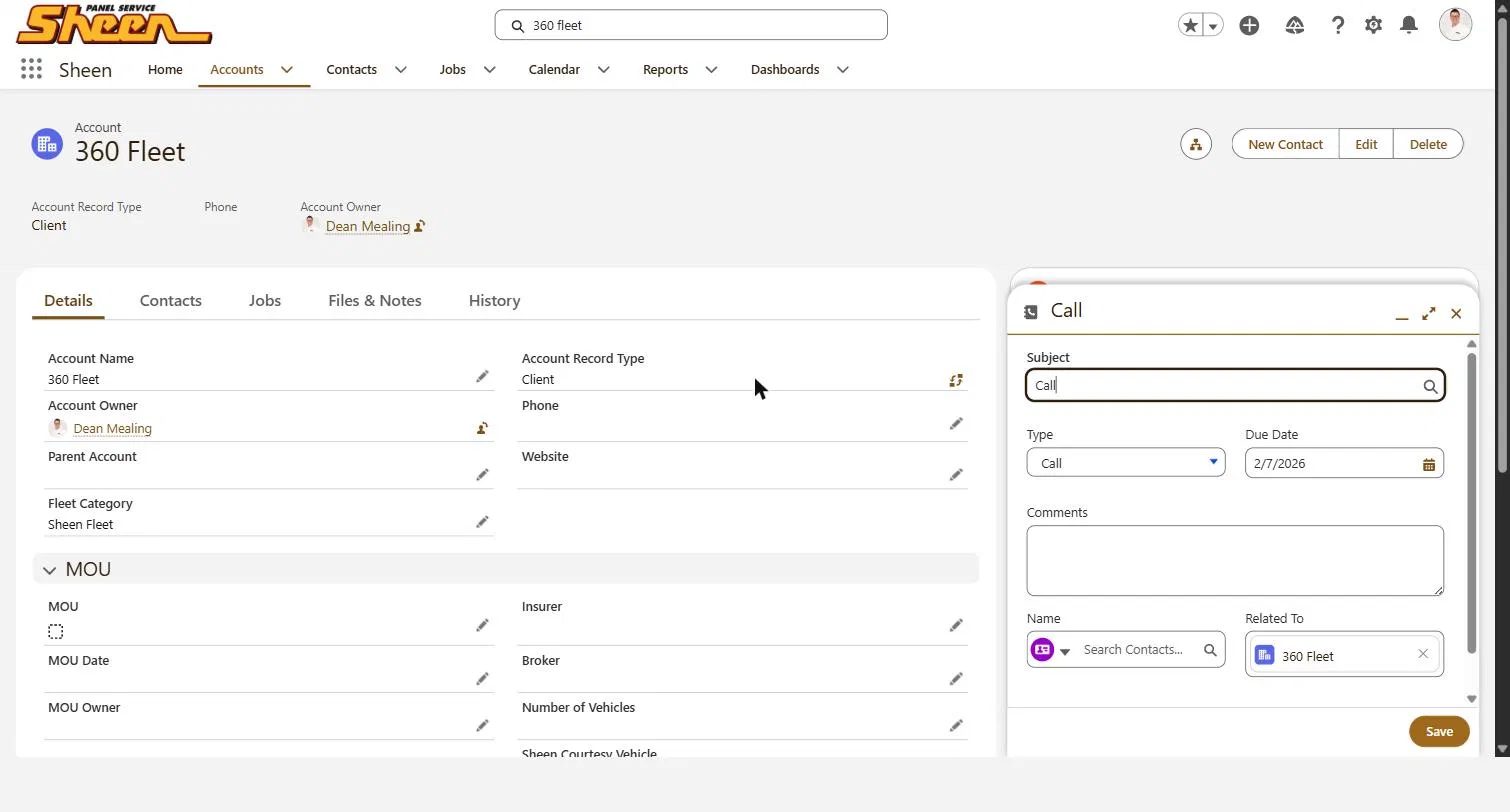
On the account page, find the Activity panel on the right and click the phone icon (Log a Call). A form opens with Related To already linked to the account you're on — leave that as it is.

Give the Subject a name that means something — "Lunch with Steve" or "Quarterly check-in call", not just "Call".

5

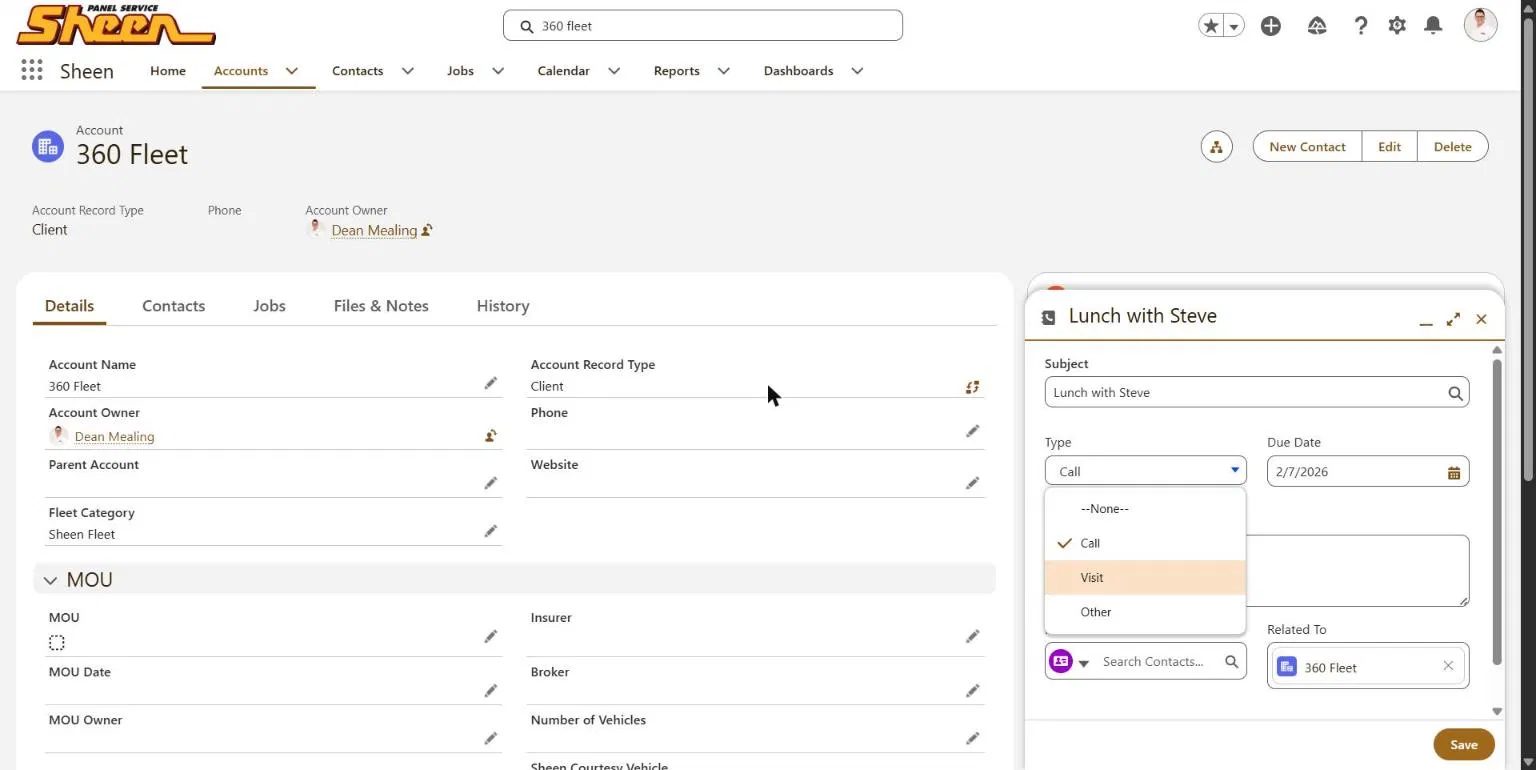
Set the Type — Call, Visit or Other
Salesforce account page for 360 Fleet with details and an open task window for Lunch with Steve call due 2/7/2026.

The Type field is what makes the compliance reporting meaningful, so pick honestly:

Type Use it for
Call Phone contact with the client.
Visit Any face-to-face — a site visit, a client dropping in, coffee or lunch.
Other Anything else worth recording (email exchange, event contact).

6

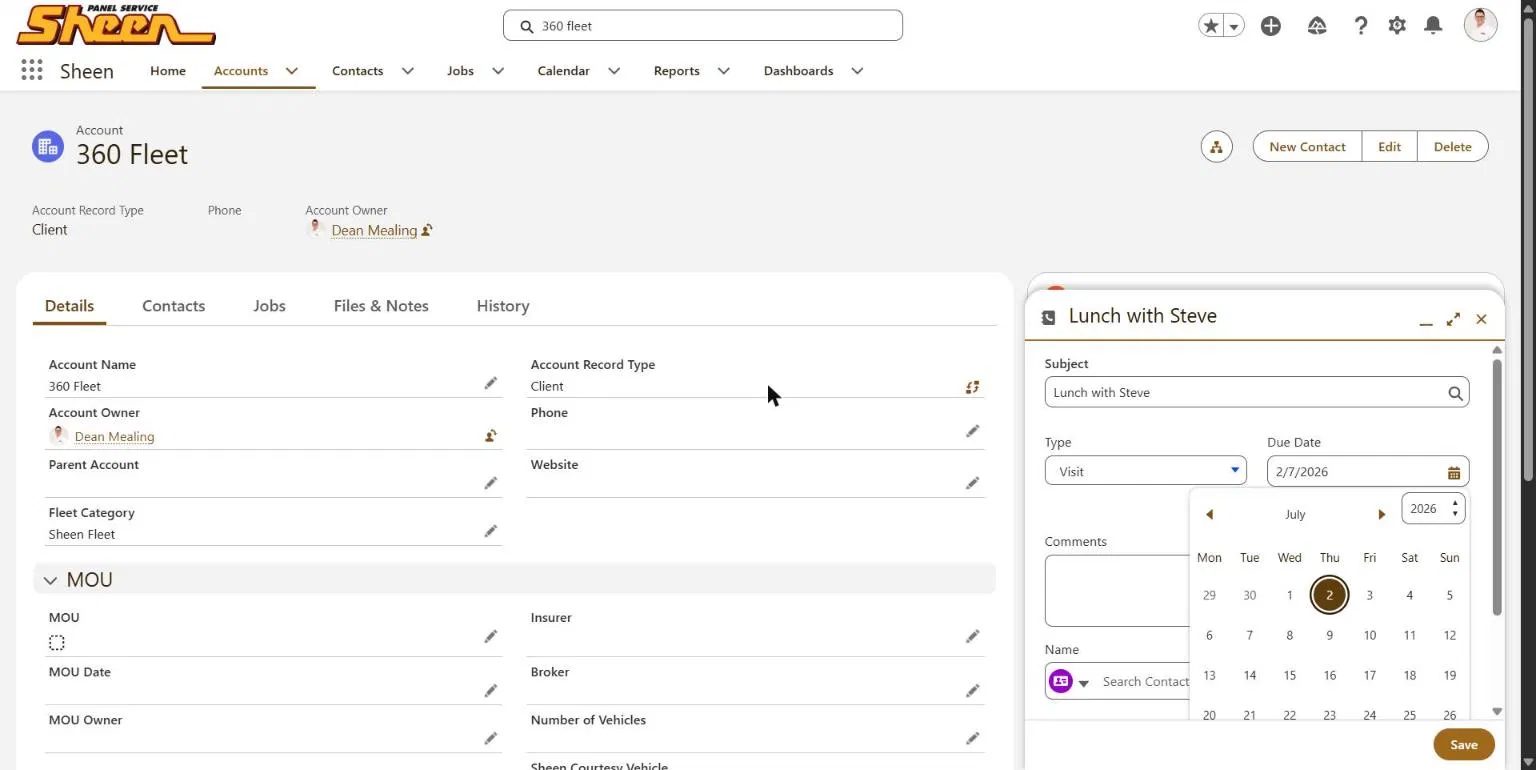
Set the Due Date

CRM page for client account 360 Fleet including details and a calendar popup setting a due date for a visit.

The date defaults to today. Two situations:

Logging something that already happened? Backdate it to the day it actually occurred (e.g. Friday's lunch logged on Monday → set Friday's date).

Scheduling a future visit? Set the future date — it will then appear in the Upcoming Due Dates panel on the Home dashboard as a reminder.

7

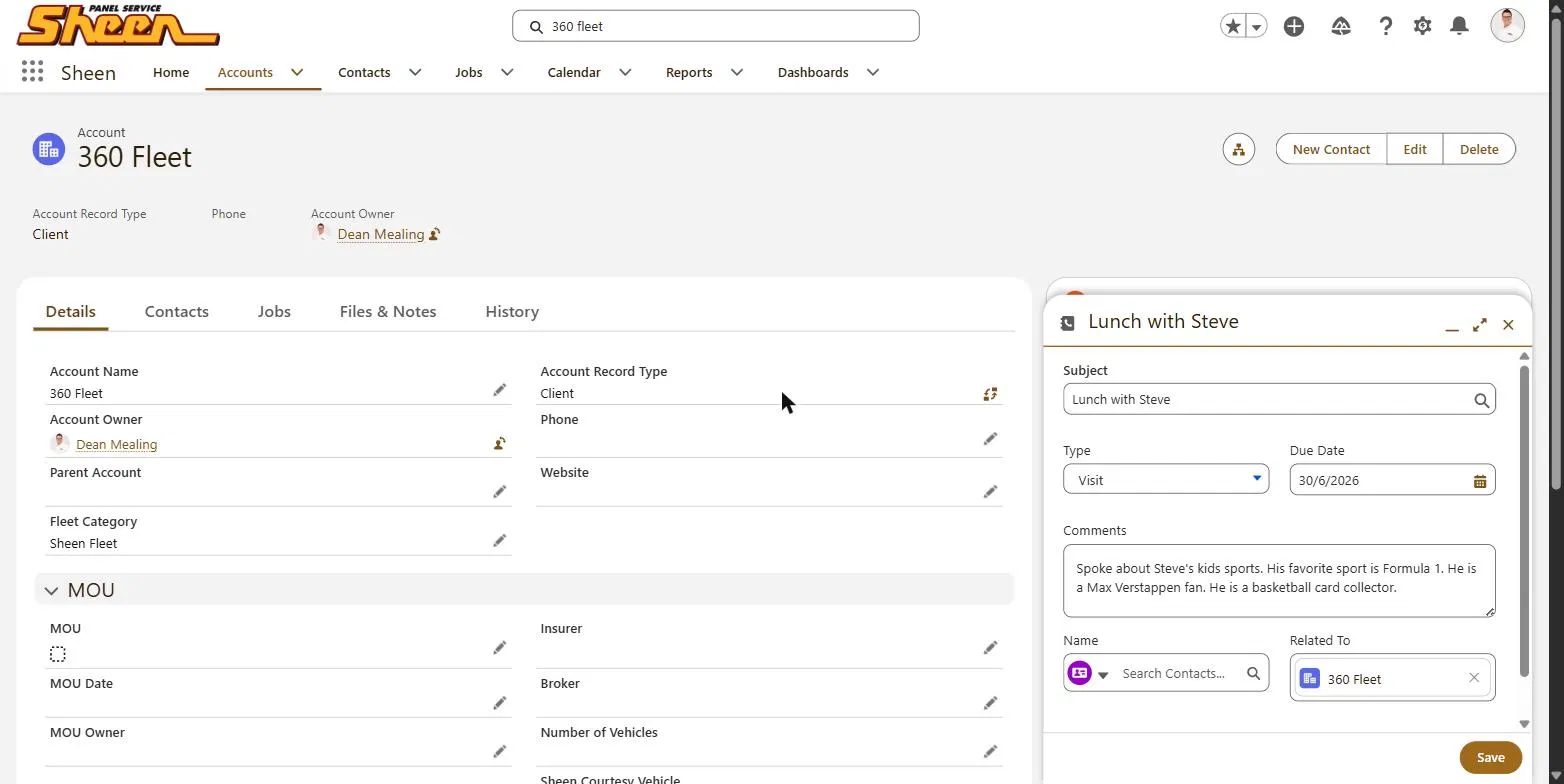
Write comments worth reading
CRM screen showing account details for 360 Fleet and a meeting note titled Lunch with Steve.

Comments are for the next person who picks up this relationship — which might be you in six months. Capture what was discussed and the personal details that keep the relationship warm: their footy team, their kids' sports, what they drive on weekends.

Good comments look like

"Spoke about Steve's kids' sports. His favourite sport is Formula 1 — Max Verstappen fan. Collects basketball cards."

Link the contact

If the person you spoke to exists as a Contact, add them in the Name field before saving. It keeps the history attached to the right human, not just the company.

8

Save — and watch the clock reset

CRM screen showing account details for 360 Fleet and a meeting note titled Lunch with Steve.

Hit Save and two things happen automatically:

1. The activity appears in the account's timeline, dated and attributed to you.

2. The Activity Frequency panel updates itself — Last Activity Date becomes your entry, the Next Activity Due date rolls forward (e.g. six months out), and the status stays Met. That's the dashboard donut staying green.

Need to fix or follow up? The ▾ menu on any timeline entry lets you Edit Comments, Change Date, or — most useful — Create Follow-Up Task so the next touchpoint books itself in.

Keeping You On The Road

Questions, missing accounts, or access issues?
Dean Mealing Fleet Account Manager
M 0473 849 789 · T 1300 249 755

Dave Carr Fleet General Manager
M 0411 141 433 · T 1300 249 755